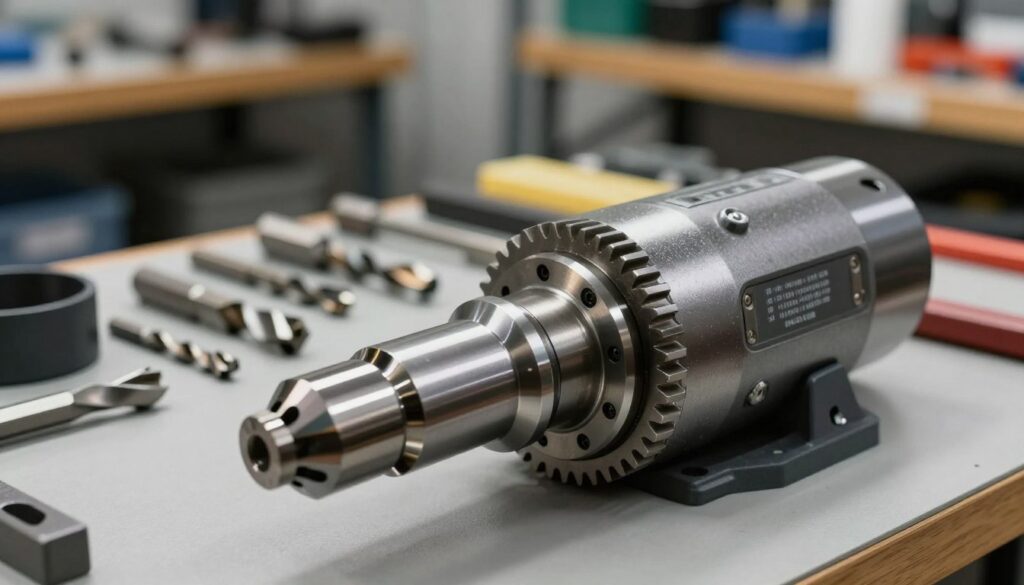
What Is a Winkelbohrspindel?
A Winkelbohrspindel is an angle drilling spindle used when a normal straight spindle cannot easily reach the working area. In simple words, it helps drill, mill, or machine at an angle, often around 90 degrees, without forcing the whole machine or workpiece into an awkward position.
The word comes from German: Winkel means angle, Bohr relates to drilling, and Spindel means spindle. So, the term clearly points to a spindle designed for angled drilling or machining tasks. It is mostly used in workshops, CNC machining centers, furniture production, metal fabrication, and industrial manufacturing.
In professional machining, access is often the real challenge. A part may have holes underneath, inside a tight corner, or along a side wall where a standard vertical spindle cannot reach. This is where the Winkelbohrspindel becomes valuable because it brings the cutting tool to the difficult area instead of moving the entire part.
How a Winkelbohrspindel Works
A Winkelbohrspindel works by transferring rotational power from the main machine drive to a tool positioned at an angle. The spindle receives motion from the machine and redirects that motion through internal mechanical components such as gears, belts, or angled transmission systems.
In many industrial units, the spindle is mounted onto a machine slide. That slide handles the feed movement and working stroke, while the angle spindle performs the cutting or drilling action. GROTEFELD describes its B200W Winkelbohrspindeln as units without their own feed, meaning they must be mounted on a machine slide that performs the infeed and working movement.
This setup gives manufacturers more control. Instead of using a separate machine for every difficult drilling angle, a business can use an angle spindle attachment or unit to complete special operations on the same production line. That saves setup time, improves repeatability, and keeps the machining process cleaner.
Main Uses of Winkelbohrspindel in Industry
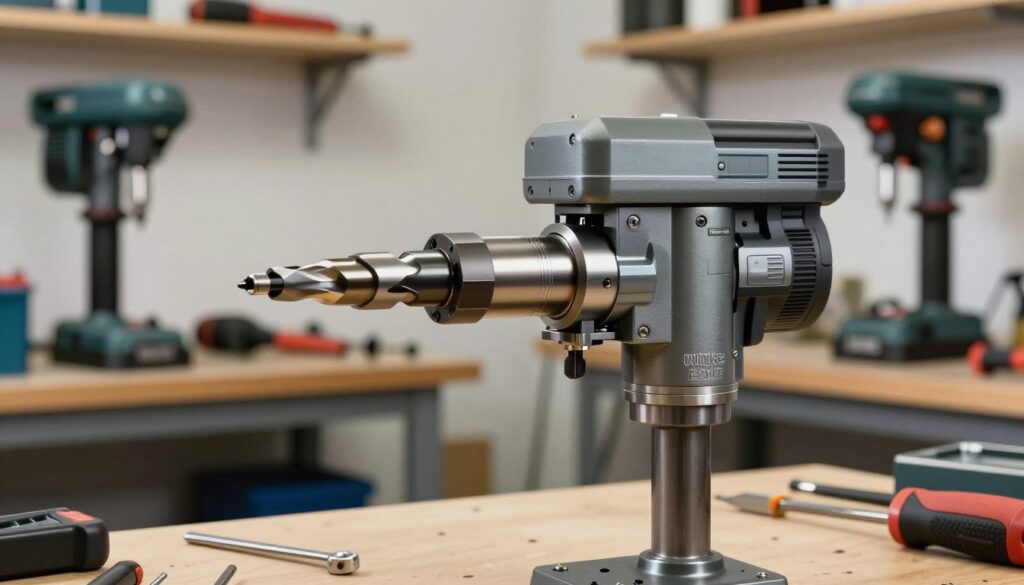
The most common use of a Winkelbohrspindel is drilling holes in tight or hard-to-reach places. These may include side holes, hidden holes, holes below a workpiece, or holes inside profiles. In furniture manufacturing, for example, angled drilling is useful for connector holes, dowel holes, cabinet joints, and assembly points.
It is also used for milling, countersinking, tapping, and light machining depending on the spindle design. BENZ angle heads, for example, are used for milling, drilling, countersinking, tapping, and other machining operations on machining centers.
Materials can vary widely. Industrial Winkelbohrspindeln may work with wood, plastics, aluminum, light metals, steel, and composite materials. GROTEFELD lists suitable materials for its B200W unit as aluminum, wood, plastics, metals, and composite materials, with typical use in electrical engineering, vehicle manufacturing, furniture production, and machine building.
Why a Winkelbohrspindel Is So Useful
The biggest advantage is access. A normal drill or spindle works well when the tool can approach the surface directly. But when the hole must be made from the side, inside a narrow space, or underneath a part, a standard setup becomes slow, clumsy, or impossible.
Another major benefit is productivity. With the right angle spindle, operators can often complete more work in one setup. That means fewer fixture changes, less workpiece repositioning, and lower chances of alignment errors. In production, even small time savings per part can become a big advantage over hundreds or thousands of components.
Accuracy is also important. A properly selected Winkelbohrspindel keeps the tool stable and aligned during the cutting process. This helps improve hole quality, surface finish, and repeatability. For CNC workshops, that repeatability is often more valuable than speed alone because consistent parts reduce waste and rework.
Types and Designs of Winkelbohrspindel
Not every Winkelbohrspindel is built the same. Some are simple 90-degree units, while others are compact, slim, multi-spindle, or adjustable. The right type depends on the space available, material, tool size, required speed, and the operation being performed.
Some angle spindle systems are built for CNC machining centers. Heimatec angle heads, for example, are available in standard 90-degree versions, recessed and slim designs, dual-spindle versions, and adjustable plus/minus 90-degree versions. They are also designed for use with industry-standard machining centers and automatic tool changers.
There are also heavy-duty and extended-reach designs. These are useful when the tool must enter deeper sections of a workpiece. BIG DAISHOWA notes that small bore angle heads are designed to reach narrow spaces with limited clearance, while extended-reach angle heads support drilling, light milling, tapping, and key slotting in deep or hard-to-reach areas.
How to Choose the Right Winkelbohrspindel
Choosing a Winkelbohrspindel should start with the job, not the tool catalog. First, look at the operation. Are you drilling, milling, tapping, countersinking, or doing several processes? A spindle that works well for simple drilling may not be strong enough for heavier milling.
Next, check the space around the workpiece. Clearance is critical. You need to know the distance from the spindle body to the cutting point, the tool length, the working depth, and the available side space. A bulky unit may have enough power but still fail if it cannot physically enter the working area.
Finally, match the spindle to the machine and material. Important details include speed range, torque, tool holding system, cooling options, spindle direction, mounting style, and feed setup. For example, GROTEFELD’s B200W model uses a belt drive and can reach spindle speeds up to 13,000 rpm in certain configurations, showing how technical specifications can vary by model and application.
Maintenance and Safe Use
A Winkelbohrspindel is a precision unit, so maintenance matters. Operators should keep it clean, check for unusual vibration, inspect tool holders, and follow the manufacturer’s lubrication or service instructions. Small problems like loose mounting, worn bearings, or poor tool clamping can quickly affect accuracy.
Safe use also depends on correct setup. The spindle must be mounted firmly, and the tool must be properly secured. The cutting speed and feed rate should match the material. Forcing the tool too hard can damage the spindle, overload the drive, or create poor-quality holes.
Good operators also listen to the machine. Strange noise, heat, chatter, or rough cutting usually means something is wrong. It could be the wrong tool, incorrect speed, poor chip removal, weak clamping, or spindle wear. Fixing these issues early protects the equipment and keeps production smooth.
Final Thoughts on Winkelbohrspindel
A Winkelbohrspindel may look like a small part of the machining process, but it can solve problems that standard drilling setups cannot handle. It gives manufacturers better access, cleaner workflow, and more flexibility when working with complex parts.
For workshops, it is especially useful when parts require side drilling, hidden holes, angled machining, or operations in restricted spaces. Instead of redesigning the whole setup, the right angle drilling spindle can make the operation faster and more practical.
Also Read: Butrflyskullmama