South Park and Trump is one of those pop culture combinations that instantly gets attention. It brings together a cartoon famous for offending almost everyone and a political figure who has dominated American news, comedy, and online debate for years. When these two worlds collide, the result is not quiet satire. It is loud, messy, uncomfortable, and usually impossible to ignore.
What makes this topic interesting is that South Park does not treat Trump like a normal political subject. The show often turns him into a symbol of media chaos, public outrage, corporate fear, and America’s strange relationship with celebrity politics. Instead of simply making a few jokes about speeches or scandals, Trey Parker and Matt Stone use Trump-era politics to explore how entertainment, power, and public reaction feed each other.
The show’s approach has changed over time. Earlier Trump-related satire leaned heavily on Mr. Garrison as a Trump-like figure, while newer episodes have used Trump more directly. That shift matters because it shows how South Park moved from parodying the idea of Trump to confronting the full media storm around him.
How South Park and Trump First Approached Trump Satire
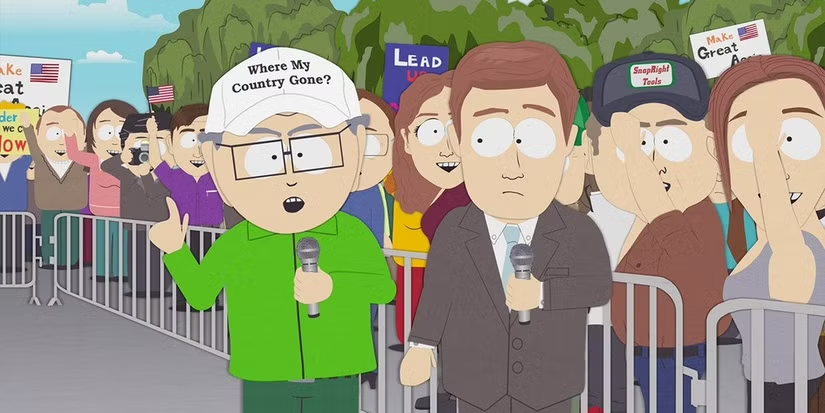
Before South Park and Trump used Trump directly in its later episodes, the show built much of its Trump-era commentary through Mr. Garrison. During the 2016 election period, Garrison’s political rise was widely understood as a parody of Trump’s move from celebrity culture into presidential politics. The Guardian reported that Mr. Garrison’s arc was “directly modelled” after Trump’s ascent to the White House.
This approach worked because South Park has always loved using absurd characters to reflect real-world absurdity. Mr. Garrison was not just a Trump copy. He became a cartoon version of political recklessness, voter frustration, and the strange energy around campaign spectacle. The joke was not only about Trump. It was also about the culture that made his rise possible.
However, the creators later admitted that mocking Trump-era politics became difficult because reality was moving faster than satire. Trey Parker said they struggled to keep up because real events were often stranger than anything they could invent. That explains why South Park and Trump became more than a simple joke topic. It became a challenge for satire itself.
Why Trump Became a Perfect South Park and Trump Target

Trump fits perfectly into the South Park and Trump because the show thrives on exaggeration, ego, conflict, and public panic. Trump’s political style, media presence, and headline-making behavior gave the writers endless material. But the show’s sharper point is not only “Trump is outrageous.” The deeper joke is that everyone around him becomes outrageous too.
That is where South Park often does its best work. It rarely focuses on one person alone. Instead, it shows how a whole town, school, company, or country reacts when one issue takes over public life. In Trump-related episodes, the citizens of South Park often become just as ridiculous as the politician they are criticizing.
This is why the show’s satire can feel harsh from every direction. Supporters may see it as an attack on Trump. Critics may notice that the show also mocks media companies, activists, voters, and internet culture. That “nobody is safe” attitude has kept South Park relevant, even when its jokes become controversial.
Season 27 Took the Trump Satire Further
The biggest modern example of South Park and Trump came with the Season 27 premiere, “Sermon on the ’Mount,” which aired on July 23, 2025. South Park Studios lists the episode as Season 27, Episode 1 and describes its story around the town facing possible ruin while Jesus returns with an important message.
This episode did not simply make Trump a background joke. It put him directly at the center of a brutal satire about politics, religion in schools, lawsuits, corporate media, Paramount, CBS, and the cancellation of The Late Show With Stephen Colbert. The Guardian reported that the premiere targeted both Trump and Paramount shortly after a major $1.5 billion deal connected to the show.
The episode’s most discussed scenes were deliberately extreme. Trump was shown in surreal and explicit satirical situations, including a controversial deepfake-style sequence. Whether viewers loved it or hated it, the point was clear: South Park wanted to push the joke so far that the controversy itself became part of the episode’s meaning.
The Paramount Angle Made the Satire Even Sharper
One reason the South Park and Trump 27 premiere hit so hard was that it did not only mock Trump. It also mocked the entertainment business behind South Park itself. That is a classic move from Parker and Stone: bite the hand that feeds them, then make the bite part of the joke.
The Guardian reported that the episode arrived just one day after a $1.5 billion agreement involving Paramount, 50 new episodes, and streaming rights. That timing made the satire feel even more daring because the show was criticizing corporate power while benefiting from a huge corporate deal.
This is what separates South Park from safer political comedy. Many shows mock politicians. Fewer shows openly mock the companies that distribute them. By mixing Trump, Paramount, CBS, lawsuits, and media fear into one storyline, South Park turned the episode into a larger argument about free speech, corporate caution, and the price of staying on air.
Public Reaction and Ratings
The public South Park and Trump was exactly what anyone familiar with South Park would expect: loud, divided, and full of headlines. Some viewers praised the episode as fearless satire. Others called it crude, unnecessary, or desperate. But in terms of attention, it clearly worked.
Business Insider reported that the Season 27 premiere attracted 5.9 million viewers across Comedy Central and Paramount+ in its first three days. Paramount also said it became the show’s “most social episode” and the most discussed program on television the night it aired.
That matters because controversy does not always equal success. In this case, the backlash, curiosity, and political debate helped turn the episode into a major television moment. The Trump satire did not push people away from watching. It pulled more people into the conversation.
Why South Park’s Trump Jokes Still Matter
The reason South Park and Trump remains such a strong keyword is simple: it sits at the crossroads of comedy, politics, media, and outrage culture. People are not only searching because they want a recap. They are searching because they want to understand why a cartoon can still create national debate.
South Park has never been polite political commentary. Its style is crude by design. That does not mean every joke lands perfectly, but it does mean the show understands one important truth: modern politics often feels like entertainment, and entertainment often behaves like politics.
Trump’s relationship with media makes him a natural subject for this kind of satire. He is not just a politician in these episodes. He becomes a mirror for lawsuits, ratings, corporate fear, fan reactions, and America’s obsession with South Park and Trump. That gives South Park more to work with than a normal political impression.
Conclusion
South Park and Trump is not just about a cartoon making fun of a president. It is about how satire survives when real politics already feels exaggerated. From Mr. Garrison’s Trump-like rise to the direct attacks in Season 27, South Park has used Trump as a way to examine American culture at its loudest and strangest.
The show’s Trump satire works because it does not stop at one target. It mocks Trump, the media, corporations, public panic, political branding, and South Park and Trump its own network. That makes the comedy uncomfortable, but it also makes it harder to dismiss.
Also Read: Severance Cast